Flat Belt Conveyor Manufacturers in Bengaluru
A Flat Belt Conveyor is a practical material handling solution for moving products and materials continuously from one location to another. Its simple operating principle, adaptable construction and smooth belt movement make it suitable for production lines, packaging operations, warehouses and other industrial material transfer applications.
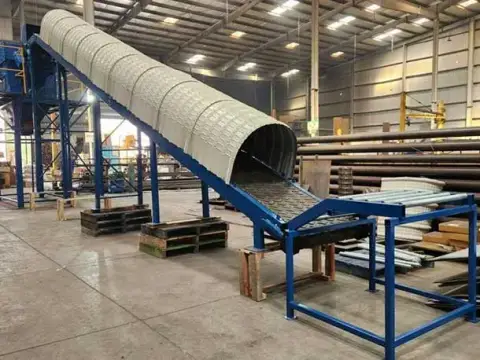
The conveyor uses a continuous flat belt supported by a structural frame and driven through a geared motor. Depending on the application, the system can be configured for horizontal, inclined or declined conveying. Belt width, conveyor length and belt material can be selected according to the handling requirement.
For companies looking for Flat Belt Conveyor Manufacturers in Bengaluru, Saksham Industrial Engineers provides conveyor solutions designed around the intended application, material characteristics and production layout.
Key Features
-
Heavy-Duty MS or SS Structure: The frame can be constructed using mild steel or stainless steel according to operating and environmental requirements.
-
Multiple Belt Material Options: PVC, PU, rubber and food-grade belt options are available for different material-handling applications.
-
Customizable Dimensions: Conveyor length and belt width can be configured according to available floor space and process requirements.
-
Variable Speed Operation: VFD-based speed control can be used where controlled material movement is required.
-
Flexible Conveyor Orientation: The system can be arranged horizontally, inclined or declined depending on the movement path.
Construction & Design
The conveyor consists of a structural frame that supports the belt and associated drive components. Mild steel or stainless steel can be selected for the main structure depending on the operating environment and application requirements.
A continuous flat belt forms the conveying surface. Belt selection is important because different materials and working conditions require different belt properties. PVC, PU, rubber and food-grade belts are available for appropriate applications.
The drive arrangement uses a geared motor to provide continuous belt movement. The overall conveyor dimensions can be adapted to the required conveying route, while variable-speed control through a VFD can be incorporated when the process requires adjustable material flow.
The design can also accommodate application-specific accessories such as side guides, cleats, scrapers, sensors and automation controls where required.
Working Process
The operating process is straightforward:
-
Loading: Material such as cartons, bags, components or packed products is placed onto the moving belt at the designated loading point.
-
Drive Activation: The geared motor drives the conveyor mechanism, causing the continuous belt to circulate.
-
Material Movement: The belt carries the material along the defined conveying path while maintaining a steady flow.
-
Controlled Transfer: Where required, VFD control allows the conveyor speed to be adjusted to suit the connected production or handling process.
-
Discharge: Material reaches the discharge point and is transferred to the next processing, packing, storage or handling stage.
-
Continuous Operation: The belt continues circulating to receive and transport subsequent material, supporting a continuous workflow.
Industrial Applications
Flat belt conveyors are useful wherever products or suitable materials need to travel repeatedly between process stages without relying entirely on manual movement. In manufacturing facilities, they can transfer components or finished goods between workstations. In packaging operations, they can move packed products toward inspection, packing or dispatch areas.
Warehouses and logistics facilities can use them for transporting cartons, packages and other unit loads along defined routes. Food processing applications can use suitable food-grade belt configurations where the product and operating conditions require them. Pharmaceutical and other controlled production environments may also require application-specific belt and structural material selection.
The conveyor can function as a standalone handling unit or be incorporated into a broader automated material movement arrangement.
Industries Served
Relevant applications include:
-
Manufacturing and assembly plants
-
Packaging units
-
Warehouses and logistics facilities
-
Food processing
-
Pharmaceutical operations
-
E-commerce distribution and material handling
-
Industrial production and processing facilities
Key Benefits
A properly selected flat belt conveyor can reduce repetitive manual material movement and provide a more organized flow between process stages. Its continuous operation helps maintain consistent product transfer while reducing unnecessary handling.
The customizable construction allows the conveyor to fit different layouts and material-handling requirements. Selection of suitable belt material can help accommodate different product types and operating environments.
Other practical benefits include relatively simple operation, low routine maintenance requirements, adjustable conveying speed where VFD control is provided, and compatibility with automation accessories. The ability to configure horizontal, inclined or declined arrangements also provides flexibility when planning material movement within a plant.
Performance & Reliability
Reliable conveyor operation depends on appropriate sizing, belt selection, loading conditions, alignment and regular maintenance. The product information specifies geared motor drive, customizable belt dimensions, variable VFD-controlled speed and MS or SS structural construction.
Routine attention should include inspection of the belt and checking its condition and tension. Proper selection of the belt material and conveyor configuration is particularly important when the system will operate continuously or handle different types of products.
Saksham Industrial Engineers also states that its products undergo quality checks and are supplied with warranty coverage. Application-specific performance requirements should be confirmed before finalizing the conveyor configuration.
Buyer Selection Guide
Before purchasing a conveyor, the buyer should first define what material will be transported and how it will enter and leave the system. Product dimensions, weight, surface characteristics and handling frequency can influence the appropriate conveyor configuration.
The required belt width and conveyor length should be established from the product size and available plant layout. Buyers should also determine whether the conveyor needs to operate horizontally, at an incline or on a decline.
Belt material is another important consideration. PVC, PU, rubber and food-grade options are available, but the correct choice should be based on the material being conveyed and operating conditions.
For applications requiring different conveying rates, variable-speed VFD control may be considered. Structural material should also be selected according to the environment and hygiene requirements. Buyers should provide details about load, dimensions, operating conditions, layout and integration requirements before finalizing the equipment.
Why Choose Saksham Industrial Engineers
Saksham Industrial Engineers was established in 2011 and provides material handling and powder handling solutions for industrial applications. The company operates as a manufacturer, supplier and technical consultant and works with global manufacturing partners.
For conveyor requirements, the company provides Flat Belt Conveyor solutions with configurable dimensions, belt materials, structural materials and conveying orientations. Its technical support can help buyers assess application requirements and determine a suitable configuration rather than selecting equipment based only on standard dimensions.
For organizations evaluating Flat Belt Conveyor Manufacturers, discussing the material, layout, capacity requirements and operating conditions with the supplier is an important step before placing an order.
Related Products
Depending on the material-handling requirement, buyers may also consider related Saksham Industrial Engineers solutions such as Telescopic Conveyor for extended loading and unloading applications, Horizontal Screw Conveyor for suitable bulk material transfer, Screw Feeder where controlled feeding is required, and Vacuum Conveying System for suitable powder-handling applications. Selecting a related system depends on the material, process and required transfer method.