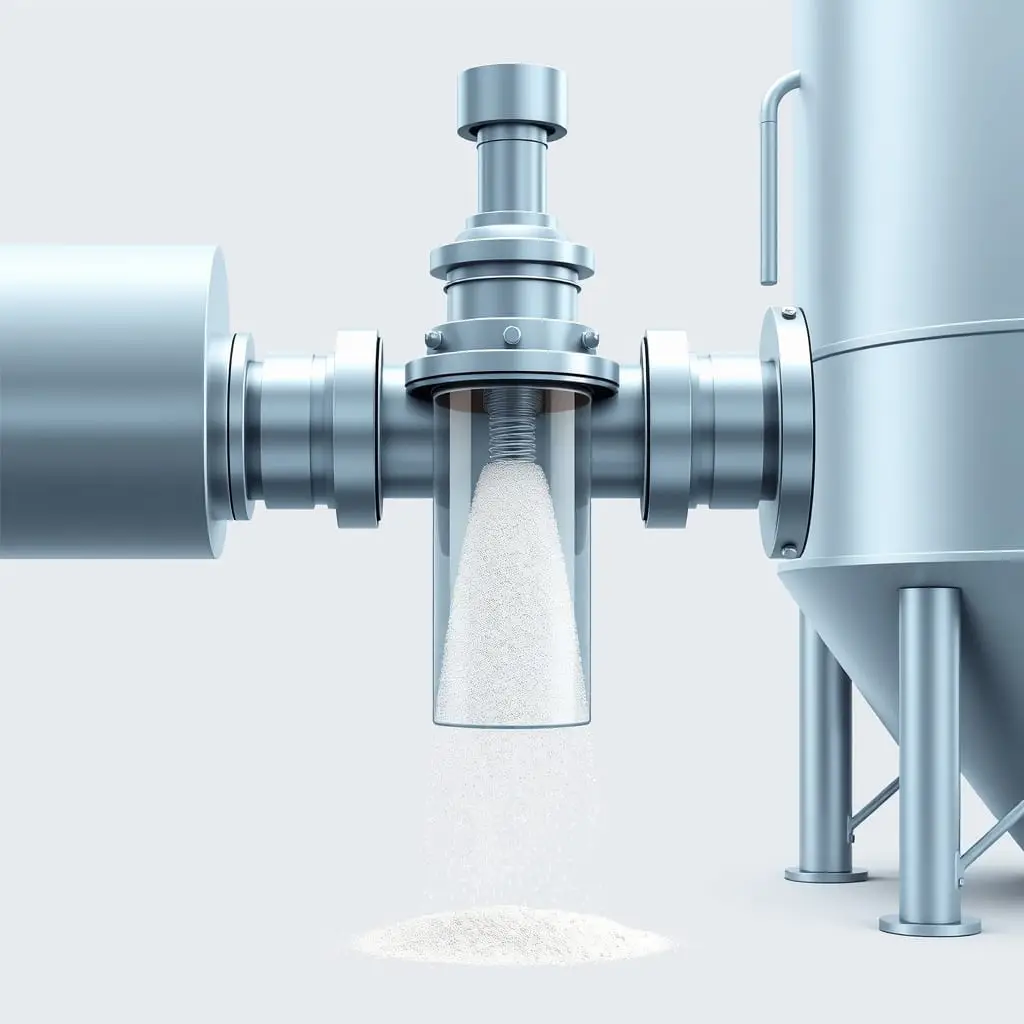
How to Choose a Diverter Valve for Powder and Bulk Material Handling?
If your plant sends powder, granules or pellets to more than one destination, a diverter valve is usually the cleanest way to do it. One conveying line can serve two silos, three mixers or four process stations without a separate feed for each.
The difficulty is that a badly chosen valve creates problems that are easy to blame on something else: material leaking into the closed leg, blockages in a pneumatic line, carry-over between products, or an actuator that cannot keep up with the duty.
So here is the short answer. Choosing a diverter valve for powder and bulk material handling comes down to five questions, best asked in this order: how many routes you need, how the material is conveyed, how the material behaves, how the valve will be operated, and how tightly it needs to seal. The sections below take each one in turn.
What a diverter valve actually does?
A diverter valve changes the path of material moving through a conveying line. Material enters through an inlet, an internal flap, plug or rotating element sets the route, and the material leaves through the selected outlet. Move the element and the material goes somewhere else.
You will find diverter valves in pneumatic conveying lines, below silos and hoppers, and in gravity chutes that feed batching and blending lines. Their value is simple: they let one source serve several destinations without duplicating conveying equipment.
Step 1: Count your destinations
Start with the number of outlets you genuinely need, including any you are likely to add in the near future. Then pick the simplest valve that covers them. A four-way valve offers more routing flexibility, but if you only have two destinations, a two-way valve is easier to specify, operate and maintain.
| Valve type | Routing arrangement | Typical situation | Size range listed by Saksham |
|---|---|---|---|
| 2 way diverter valve | One common inlet to either of two outlets | Splitting a line between two silos, hoppers or process lines | 50 mm to 300 mm, custom sizes available |
| 3 way diverter valve | Three connected ports; one inlet to either of two outlets, or the reverse arrangement depending on configuration | Several bins, mixers or stations sharing a common route | 100 mm to 500 mm, custom sizes available |
| 4 way diverter valve | Four routing directions | One material stream distributed among several silos, bins or lines | 100 mm to 400 mm, customizable |
These ranges come from the current product pages. Confirm them against the exact configuration you plan to order.
Step 2: Match the valve to your conveying method
Gravity chutes, dilute-phase pneumatic lines and mechanical conveyors place very different demands on a diverter. Saksham's product information lists plug, flap and rotary arrangements, and the right one depends on how your system moves material.
As a general rule, flap-type diverters are common in gravity chutes and lower-pressure duty where the flow path is simple. Plug and rotary designs are often considered where sealing matters more, such as pneumatic lines carrying fine powder. This is general guidance rather than a rule, so ask your supplier how the chosen design seals and what duty it is intended for.
Also look at the inside of the valve. The bore should line up with your pipe or chute, and there should be no steps, gaps or pockets where powder can collect. In a pneumatic line, abrupt changes can add pressure drop and encourage build-up.
Step 3: Look closely at your material
The same valve will behave very differently with flour, cement or plastic pellets. Think about these properties before you request a quotation:
- Fine, dusty powders need good sealing so that dust does not escape and material does not leak into the closed route.
- Abrasive materials wear internal surfaces faster. Saksham lists PU, ceramic and rubber lining options on its 3 way diverter valve page for applications where abrasion is a concern, so ask about lining early rather than after the first failure.
- Sticky or moisture-sensitive powders tend to build up, so smooth internal surfaces and easy access for cleaning matter.
- Food and pharmaceutical products usually call for stainless steel. SS304 and SS316 are among the construction options listed, but do not assume any particular food-grade certification unless the supplier confirms it for your specific valve.
- Combustible dusts need input from your safety or process team. Check what protection requirements apply to your plant before the valve is specified.
Step 4: Decide how the valve will be operated
Manual, pneumatic and electric operation are all available across Saksham's diverter valves. Manual operation can work where routes change rarely and an operator is nearby. Pneumatic or electric actuation makes more sense when the valve is part of an automated sequence or sits somewhere hard to reach.
Two practical points. First, check what you actually have available: compressed air at the right location, or a power supply and control wiring. Second, ask whether position feedback can be supplied, so your control system can confirm that the valve has fully moved before conveying starts.
Step 5: Think about sealing and cross-contamination
A diverter that leaks lets some material slip into the route that should be closed. Depending on your process, that can mean contaminated product, wasted material, or air bypassing in a pneumatic line.
If you run different products through the same line, ask how the valve can be cleaned and inspected, and how easily the seals can be replaced. For fine powders, the sealing arrangement deserves as much attention as the valve size.
Size, pressure and temperature: confirm, do not assume
Size the valve to your conveying line and the throughput you need, not to a catalogue category. Pressure and temperature figures also need care. The figures published for different models can vary, and the product pages themselves advise that they should be confirmed for the exact configuration. Share your real operating pressure and temperature, including any peaks, and get the limits confirmed in writing.
Do you need a diverter valve at all?
Sometimes the real requirement is a different valve. A diverter changes direction. It does not necessarily stop flow or regulate discharge.
- To start, stop or isolate flow at a hopper or silo outlet, a slide gate valve is the usual choice, and it is also handy for isolating equipment during maintenance.
- To meter discharge from a hopper, filter or cyclone while limiting air movement between two zones, look at a rotary airlock valve.
In a larger system these can sit alongside a diverter, each doing its own job.
Checklist before you request a quotation
- Material name and behaviour: particle size, bulk density, abrasiveness, moisture and stickiness.
- Number of destinations, now and in the near future.
- Conveying method: gravity, pneumatic or mechanical.
- Line or chute size and required throughput.
- Operating pressure and temperature, including peak values.
- Body material, lining and hygiene requirements.
- Manual, pneumatic or electric operation, and the utilities available.
- Mounting orientation, connection type and available space.
- Access for inspection, cleaning and seal replacement.
Frequently asked questions
What is the difference between a 2 way, 3 way and 4 way diverter valve?
The number refers to the connected routes. A two-way valve sends material from one inlet to either of two outlets. A three-way valve has three connected ports and can also be arranged to work in reverse. A four-way valve offers four routing directions for plants with several destinations.
Can one diverter valve be used for both pneumatic and gravity systems?
Some configurations can. Saksham's 3 way and 4 way product pages mention pneumatic and gravity conveying, while the 2 way page highlights pneumatic conveying and silo or hopper discharge. Duty still depends on pressure, material and design, so confirm it for your application.
Should I choose manual, pneumatic or electric operation?
Manual suits occasional route changes with easy operator access. Pneumatic or electric operation suits automated plants, remote locations and frequent switching. Let your control system and available utilities guide the choice.
Which material of construction is right for my powder?
The options listed include mild steel (or carbon steel), SS304 and SS316. Stainless steel is often considered for hygienic or corrosion-sensitive duties, while abrasive materials may also need a lining. The right choice depends on your material, environment and cleanliness requirements.
What information should I send my supplier?
Send the material details, destinations, line size, throughput, pressure, temperature, preferred construction, operation type and space constraints. The checklist above covers everything a supplier typically needs to recommend a suitable configuration.
Choosing with confidence
The best diverter valve is the one that matches your routes, conveying method, material and control setup, not simply the one that fits the pipe. If you are comparing options, you can explore Saksham Industrial Engineers' diverter valve range, then send your process details through the contact page so the right configuration can be discussed against your actual application.
