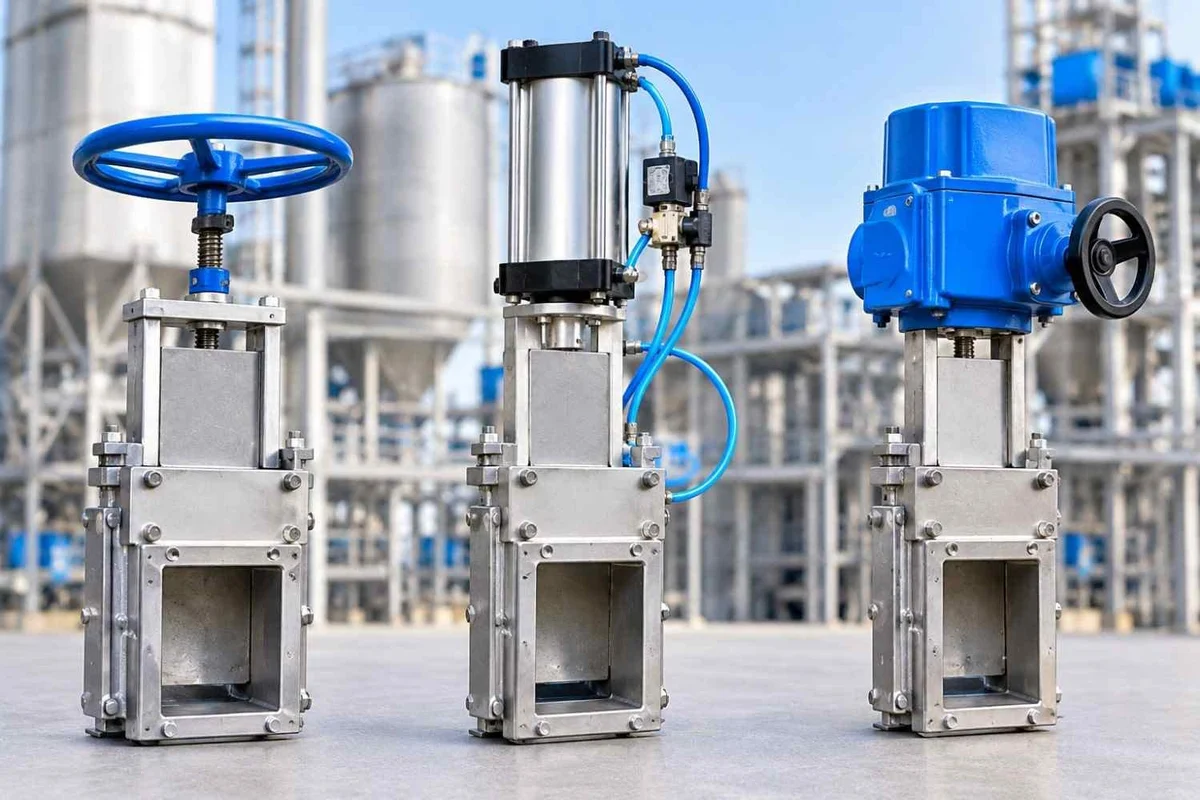
The right operating type depends mostly on how often the valve moves, whether it needs to work automatically, and what utilities you already have at that point in the plant. A manual slide gate valve suits points that are operated rarely and are easy to reach. A pneumatic valve suits automated lines with compressed air. An electric (motorized) valve suits automated points where compressed air is not practical.
The gate, body and seals can be the same in all three cases. What changes is the part that moves the gate, and that choice affects cost, control, safety and upkeep for years. This guide compares the three options so you can decide before you request a quotation.
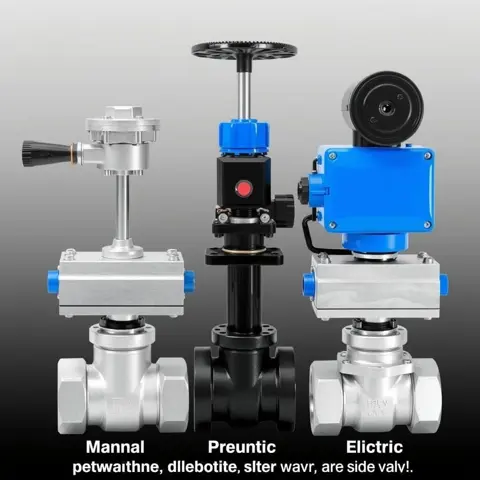
What actually changes between the three types?
A slide gate valve works by moving a flat gate across the material opening. If you want a refresher on the basics, see our guide on what a slide gate valve is and where it is used.
The three operating types differ only in how that gate is moved:
- Manual: a person turns a handwheel or moves a lever.
- Pneumatic: a compressed-air cylinder moves the gate, usually through a solenoid valve that receives a signal from a controller.
- Electric: an electric drive moves the gate, powered and controlled through a motor starter or control panel.
The slide gate valve offered by Saksham Industrial Engineers is listed with manual, pneumatic and motorized operation. In this article, “electric” and “motorized” mean the same thing.
Quick comparison
| Factor | Manual | Pneumatic | Electric (motorized) |
|---|---|---|---|
| Needs a utility supply | None | Clean, dry compressed air | Electrical power |
| Works from a control room | No | Yes | Yes |
| Typical use | Occasional isolation | Frequent, automated cycling | Automated points without an air supply |
| Operator access needed | Yes, at the valve | Only for maintenance | Only for maintenance |
| Initial complexity | Lowest | Moderate (air line, solenoid, wiring) | Moderate (power, wiring, controls) |
| Main upkeep concern | Mechanism and gate guides | Air quality, cylinder, solenoid | Drive, limit switches, wiring |
Treat this as general guidance. Speed, force and control features vary between designs, so ask your supplier for the figures that apply to your configuration.
Manual slide gate valves
A manual valve is the simplest choice. There is no air line, no wiring and no controller to maintain. That makes it a good fit where the valve is closed for maintenance or changeovers and then left alone.
Where it makes sense:
- Isolation points below a hopper or bin where staff need to take a feeder out of service.
- Small plants and batch operations where an operator is already nearby.
- Backup isolation placed ahead of an automated valve.
Limits to think about:
- Someone has to reach the valve every time. A gate fitted high up or in a hard-to-reach spot becomes a safety and convenience problem.
- It cannot respond to a signal from the process, so it cannot take part in an automated sequence.
- Large valves under load can be physically demanding to operate by hand. Discuss gate size and material pressure with your supplier.
Pneumatic slide gate valves
A pneumatic valve opens and closes on a signal. That makes it the usual choice when the valve is part of an automatic line, such as a batching system or a hopper that fills and discharges in cycles.
Where it makes sense:
- Plants that already have a compressed air network.
- Lines where the valve cycles often and must be controlled remotely.
- Sites where a pneumatic actuator is already the standard, so spares and training are familiar.
What to plan for:
- Air quality and supply. Clean, dry air at the right pressure protects the cylinder and solenoid. A plant without a reliable air supply will find a pneumatic valve unreliable.
- Behaviour when air is lost. Some actuator designs stay in position, while others move to a set position. Decide which is safer for your process and ask for the configuration you need.
- Air consumption. Many valves on one line add up, so check that your system can support them.
Electric (motorized) slide gate valves
An electric valve uses a motor drive instead of air. It also takes a control signal, but it does not depend on a compressed air network.
Where it makes sense:
- Locations where running an air line is costly or impractical.
- Plants where electrical power and control wiring are easier to provide than compressed air.
- Applications where the gate may need to be stopped at a chosen position, if the drive and controls are specified for it.
What to plan for:
- Wiring and controls. The drive needs power, protection and a control interface. Limit switches or position feedback should be agreed at the order stage.
- Operating speed. Electric drives are often slower to move the gate than a pneumatic cylinder. If fast cycling matters, ask for the cycle time of the exact model.
- Dusty environments. If your material can form an explosive dust atmosphere, electrical equipment may need to meet specific area-classification rules. Check your site requirements and confirm the options with the supplier. Do not assume a standard drive is suitable.
How to decide: six practical questions
- How often does the valve move? Rarely suggests manual. Many times per shift suggests pneumatic or electric.
- Does it need to take part in an automatic sequence? If yes, choose pneumatic or electric.
- What utilities are already at that location? Compressed air favours pneumatic. Power without air favours electric.
- Can an operator reach it safely and quickly? If not, automate it.
- What should happen on a power or air failure? Decide the safe position and tell your supplier.
- What does your maintenance team already know? Familiar technology means faster repairs and fewer mistakes.
It does not have to be one type everywhere
Many plants mix operating types. A common arrangement is a manual slide gate as a maintenance isolation point, with an automated valve doing the daily work further down the line. In an automated line the valve usually receives its signal from a controller. A paddle level sensor can provide a simple level signal from a silo or hopper, which the control system can use to decide when to open or close a gate.
The valve below the gate also matters. A screw feeder controls the feed rate, while a rotary airlock valve handles continuous discharge between pressure zones. In both cases the slide gate acts as the isolation point above, and its operating type should suit the rest of the line.
Common mistakes to avoid
- Choosing manual for a hard-to-reach location and then leaving the valve unused because nobody wants to operate it.
- Specifying pneumatic without checking the air supply at that point in the plant.
- Ignoring the failure position, which only becomes important when power or air drops unexpectedly.
- Forgetting the control signals. Decide early whether you need open and closed position feedback, and how the valve will connect to your controller.
- Ordering by actuator type alone. Material, gate size, sealing and construction still need to match the application.
Information to send your supplier
To get a useful recommendation, share these details:
- Material type, and whether it is abrasive or prone to caking.
- Opening size and connection type.
- Mounting position, horizontal or vertical.
- Operating frequency and whether the valve is part of an automatic sequence.
- Available utilities at the valve: compressed air, power supply and voltage.
- Temperature and pressure at the valve location.
- Any hazardous-area or hygiene requirements.
The product page lists a size range of 100 mm to 600 mm, mild steel or SS304/SS316 construction, and temperature and pressure figures. Please confirm those figures for your exact configuration before ordering.
Frequently asked questions
Is a pneumatic or electric slide gate valve better?
Neither is better in every case. Pneumatic suits plants with a reliable compressed air network and frequent cycling. Electric suits automated points where compressed air is not available or practical.
When is a manual slide gate valve enough?
When the valve is operated occasionally, is easy to reach, and does not need to be controlled from a distance. Isolation for maintenance is the typical use.
Can I upgrade a manual valve to an automatic one later?
It may be possible, but it depends on the valve design and available space. If you expect to automate the line in future, tell the supplier at the ordering stage so the valve can be configured accordingly.
What happens to a pneumatic valve if the air supply fails?
That depends on the actuator design. Some designs hold their last position and others move to a set position. Choose the behaviour that is safest for your process and confirm it with the supplier.
Do electric slide gate valves work in dusty areas?
They can be used in dusty plants, but if your material can create an explosive atmosphere you need equipment suitable for that area classification. Check your site requirements and confirm the options with the supplier.
What information do I need for a quotation?
Material details, opening size, mounting position, operating method, available utilities, and temperature and pressure at the valve location.
Choosing the right operating type
Pick manual for rarely used, easy-to-reach points. Pick pneumatic for automated lines with a dependable air supply. Pick electric for automated points where power is easier to provide than compressed air. The best choice is the one that matches your control system, your utilities and the people who maintain it.
To compare options for your plant, review the slide gate valve range from Saksham Industrial Engineers, or contact the team with your material, valve size and operating details.Start writing your blog article here...
